Stonyisland history
Stony Island Avenue is a major street on South Side of the city of Chicago, designated 1600 East in Chicago’s street numbering system. It runs from 56th Street south to the Calumet River. Stony Island Avenue continues sporadically south of the Calumet in the southern suburbs, running alongside the Bishop Ford Freeway, sometimes as a frontage road. It terminates at County Line Road on the border of Will and Kankakee Counties.
Running roughly parallel to the Illinois Central Railroad, Stony Island Avenue forms the western boundary of Jackson Park, former home of the World’s Columbian Exposition of 1893 and current home of the Museum of Science and Industry. Buildings of the University of Chicago line its western side, as does the national headquarters of the historically black Alpha Kappa Alpha sorority. Between 59th and 60th streets the Midway Plaisance runs westward to connect Jackson Park to Washington Park a mile away. Shortly after leaving the Hyde Park neighborhood sits Hyde Park Career Academy at 63rd Street. The Barack Obama Presidential Center is slated to be built in Jackson Park across from the high school.
Southmoor Hotel
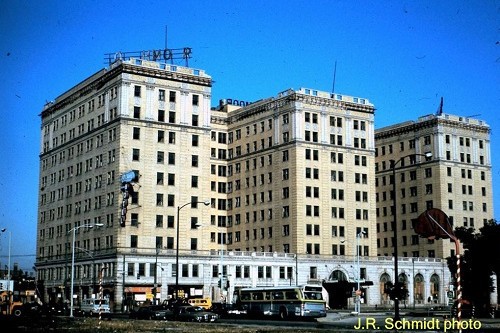
In 1924 the Southmoor Hotel opened on the northwest corner of Stony Island Avenue and 67th Street. With 300 elegant rooms and a prime location at the southwest entrance to Jackson Park, it soon became a jewel of the South Shore community.
The Southmoor was one of many residential hotels that once dotted Chicago’s finer neighborhoods. Two historic events distinguished the Southmoor from the others. Most famously, The Woodlawn Organization was formally organized during a meeting at the hotel in 1962. A lesser-known incident occurred seven years earlier—during his first Chicago concert tour, Elvis Presley hid out from his fans in the Southmoor.
The hotel started to slide in 1969, when management unknowingly hired some members of a local street gang. Within months the gangbangers had run off the residents and the other employees, and established the Southmoor as their headquarters.
A Time magazine story on this particular form of adaptive re-use didn’t sit well with Mayor Richard J. Daley. The city seized the building, kicked out the thugs, and launched a fruitless search for someone who’d restore the property. In 1977, shortly after I took the photo of the vacant hulk, the Southmoor was demolished.
The Republic
Installed in 1918, the Statue of the Republic commemorates the twenty-fifth anniversary of the World’s Columbian Exposition in Jackson Park and the centennial of statehood for Illinois. The twenty-four-foot-tall gilded bronze sculpture is a much smaller and slightly modified version of Daniel Chester French’s original sixty-five-foot-tall Statue of the Republic, one of the most iconic features of the World’s Columbian Exposition of 1893. (On its base, the original sculpture rose to a total height of one hundred feet.) Composed of gilded plaster, the original monumental female figure stood with outstretched arms at the eastern end of the fair’s Court of Honor.
At that time of the exposition, the Statue of the Republic was among the nation’s tallest sculptures. It was second only to the New York’s Statue of Liberty, the famous gift from the People of France to commemorate the centennial of the signing of the Declaration of Independence. Though temporary in nature, Chicago’s colossal Statue of the Republic was widely admired. By the turn of the century, Daniel Chester French (1850–1931) had received recognition as one of the nation’s leading sculptors. French later went on to produce the work for which he is best known—the monumental figure of Abraham Lincoln for the Lincoln Memorial in Washington, D.C.